
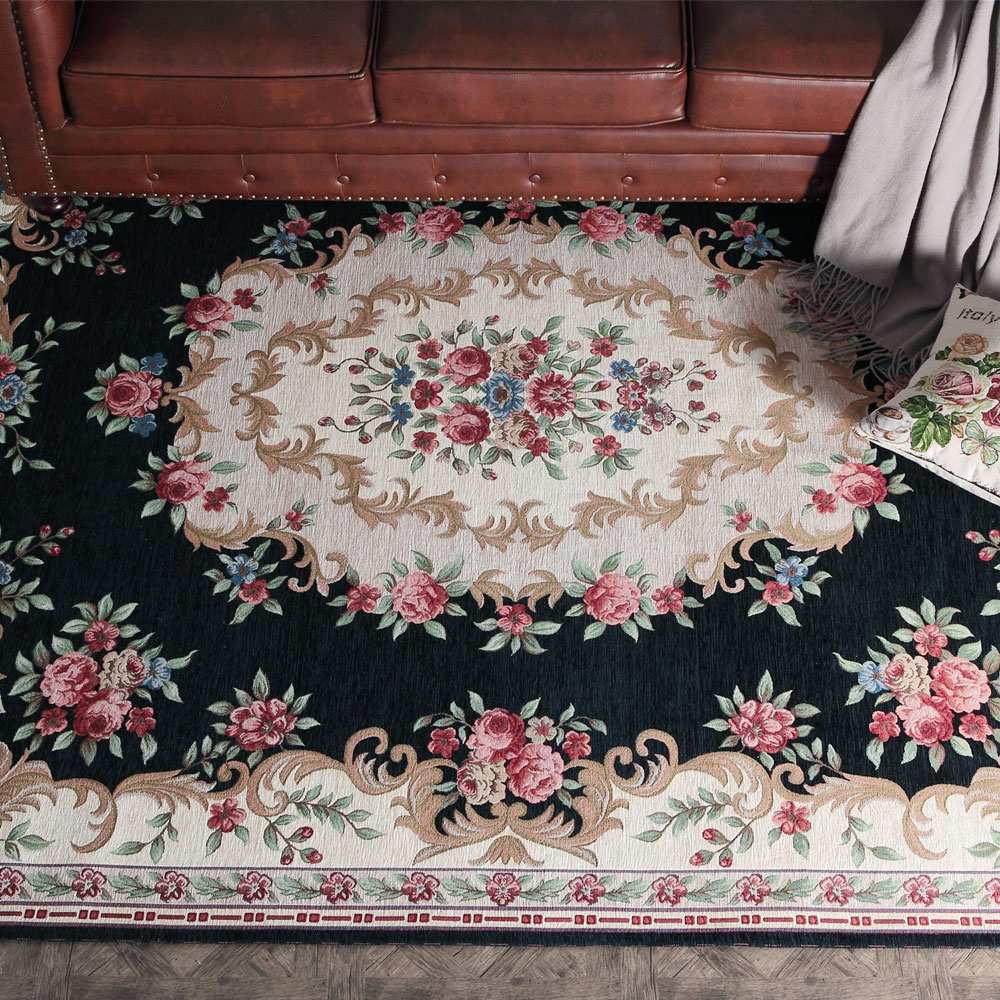
Approve a floral rug design with a proof that names the border, central motif, corners and the orientation used for review. Link that proof to the exact product and requested size, then record which region each correction affects. Jiabolang’s Carpet 029, 048 and 059 are separate catalogue references. Their room scenes help identify a design, but they do not show the complete artwork presentation of every offered dimension. A region map closes that gap without changing the buyer’s size-assortment plan.
Identify the exact design before marking corrections
Start with the complete code and reference image for Flower Pattern Carpet 029. Preserve leading zeros in the code and attach the requested size to the proof record. A broad description such as the dark floral rug is not enough when the catalogue contains several related decorative designs.
Keep Carpet 048 and Carpet 059 on different proof records even when they belong in the same merchandising collection. A shared floral theme or a similar staged room does not make them versions of one approved artwork. The purpose here is to specify the visible design being reviewed, not to decide the assortment’s quantities or infer the construction of the carpet.
• Exact product code and proposed design revision.
• Requested size linked to its own proof view.
• Region references and the orientation used for review.
Name the centre, border and corners separately
Use a simple region key on the requested proof: central area, surrounding field, border and corners where those areas are relevant to the design. The labels identify questions; they are not measurements of the catalogue photograph. Ask the supplier to show which part of the proposed artwork each label refers to.
Describe a correction at the relevant region rather than asking for the whole rug to look more balanced. For example, a buyer can ask the supplier to clarify the proposed centre position or the continuity of the shown border. Keep the requested change distinguishable from the supplier’s returned proposal and from the buyer’s final appearance decision.
Proof region
Question for the supplier
Do not infer
Central motif
Where is its reference centre in this version?
A location measured from a perspective room scene
Border
Which visible treatment applies to each side?
The same presentation at every listed size
Corner
How is the proposed corner detail presented?
A detail hidden beneath scene furniture
Orientation
Which marked edge defines the review direction?
A universal top derived from the photograph
Set an orientation reference the reader can follow
Ask the supplier to mark a reference edge on the proof and use that edge consistently in comments. A phrase such as move the flowers to the left is ambiguous when two reviewers view an image in different orientations. Use the region labels and the defined reference edge so that the requested change remains understandable.
A catalogue scene may crop an edge, place furniture over a region or show the rug at an angle. Those conditions make it unsuitable as a scaled plan. Request a complete model-specific view for the artwork question instead of rotating or stretching the room photograph and presenting the result as a confirmed production layout.
Request the design view for the selected size
A size list identifies options to discuss, while a proof shows the design proposed for a specific request. Ask for the relevant size-linked artwork reference where motif placement matters. Keep the source dimensions and the supplier’s current offered version distinct from any buyer-requested alternative.
Do not assume that a border, corner or central motif retains exactly the same relationship in every dimension. Likewise, do not claim that the supplier will scale, repeat or crop the design in a particular way unless the response actually confirms that method for the selected item. Record what has been proposed and which questions remain unanswered.
Separate colour comments from material acceptance
Record a visible colour comment against the same product, region and proof revision. If the parties need to compare appearance under a common setup, state which reference they used. A screen view is a shortlisting aid; it does not establish a measured colour tolerance or the appearance under every lighting condition.
Keep fibre, backing, edge construction and performance requirements outside the artwork decision. Approval of a floral arrangement does not verify those physical properties. Decorative cushions, furniture and other scene elements also should not become assumed parts of the offered carpet unit.
Return one consolidated correction record
Collect the buyer’s comments into a single correction list linked to the proof revision. Give each item a region, requested change and response state. This prevents a supplier from receiving several unconnected screenshots whose arrows refer to different versions of the artwork.
Retain the previous proof when the supplier returns an update. Check whether the specific requested changes have been addressed and record the review scope. A new image should not silently replace the earlier reference without showing why it changed or which regions were reconsidered.
Keep the accepted artwork with the sample request
Attach the accepted design reference to the sample or order discussion and identify what the acceptance covers. If a physical sample is later received, record that sample separately. The catalogue scene and the digital proof do not establish that the actual sample has been measured or independently inspected.
Send the region map and open questions through Jiabolang contact. The carpet blog provides related buying topics, while the proof record preserves this particular design decision. Material evidence, packing, current availability, price, minimum quantity and timing require their own supplier responses rather than being implied by artwork approval.
Frequently asked questions
Does a catalogue scene show the complete design at every size?
No. Ask for the model- and size-specific proof needed for the actual order. Do not infer scaling, repetition or cropping from one room photograph.
How should left and right be defined in a correction?
Use a marked reference edge and region key on the same proof revision. Avoid directions that depend on how a reviewer happens to rotate the image.
Can a proof approval confirm backing or fibre properties?
No. Keep visible design acceptance separate from physical construction and performance information.
Should an updated image replace the earlier proof?
Retain both and identify which correction the new revision addresses. Record the scope of the accepted change.
Product and contact references
https://jblcarpets.com/product/flower-pattern-carpet-029/
https://jblcarpets.com/contact/
https://jblcarpets.com/blog/